
Not every door in a commercial or industrial facility serves the same purpose. Some openings experience constant activity throughout the day, while others may only be used occasionally. Yet many facility owners make the mistake of selecting the same type of door for every opening, regardless of how frequently it will operate.
The reality is that choosing the right overhead door involves much more than appearance, size, or upfront cost. One of the most important factors to consider is cycle frequency: the number of times a door opens and closes each day.
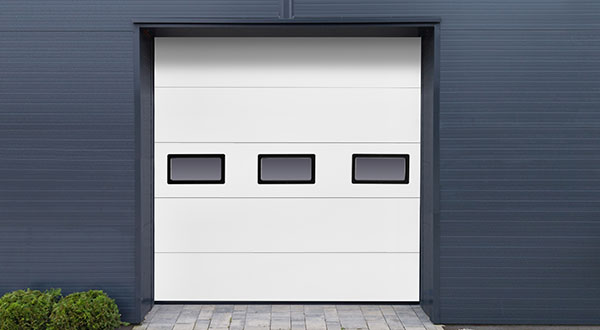

The right door in the right location can have a significant impact on your operation. The wrong door can lead to unnecessary repairs, downtime, and frustration.
What Does "Cycle" Mean?
In the overhead door industry, a cycle refers to one complete opening and closing operation.
For example:
Open + Close = 1 Cycle
50 openings and closings per day = 50 cycles
200 openings and closings per day = 200 cycles
Every commercial overhead door is engineered with a specific cycle capacity in mind. Components such as springs, motors, drive systems, rollers, tracks, and safety devices are designed to withstand a certain amount of use over their lifespan.
This is why understanding traffic patterns within your facility is essential when selecting the right door system.
Understanding Low-Cycle Doors
Low-cycle doors are designed for openings that experience limited traffic and infrequent operation.
These doors provide dependable performance while keeping installation costs lower than specialized high-cycle systems.
Common examples include:
✓ Traditional sectional overhead doors
✓ Standard rolling steel doors
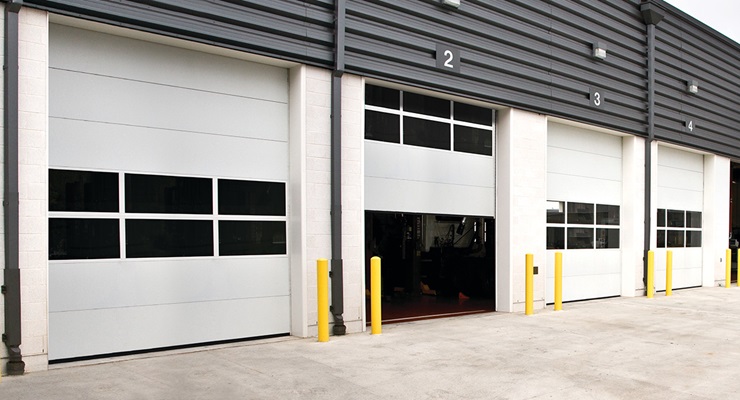
✓ Coiling service doors
✓ Fire-rated doors
✓ Security shutters
✓ Certain insulated commercial doors
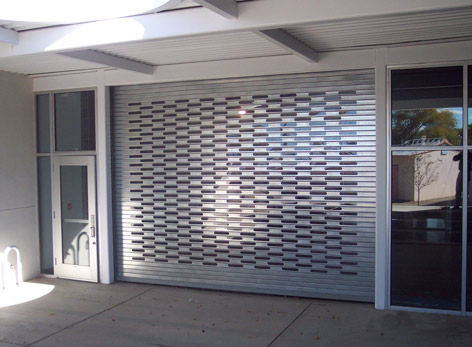
These door systems are excellent choices for openings where traffic is occasional rather than constant.
Low-cycle doors are commonly installed in:
✓ Storage areas
✓ Maintenance rooms
✓ Equipment rooms
✓ Secondary warehouse entrances
✓ Utility buildings
✓ Mechanical spaces
✓ Emergency access points
✓Low-traffic commercial facilities
In these environments, a conventional commercial door can provide years of reliable service without requiring the advanced capabilities of a high-speed door.

 Understanding High-Cycle Doors
High-cycle doors are specifically engineered to handle frequent operation throughout the day.
Often referred to as high-speed doors, rapid-roll doors, fast-acting doors, or high-performance overhead doors, these systems are built for demanding environments where efficiency and uptime are critical.
Unlike conventional overhead doors, high-cycle doors are designed to operate hundreds of times per day while maintaining reliable performance.
Features commonly include:
✓ High-speed opening and closing
✓ Advanced drive systems
✓ Heavy-duty components
✓ Enhanced safety technology
✓ Intelligent controls
✓ Reduced maintenance requirements
✓ Superior environmental separation
These doors are often found in facilities where every second matters.
High-speed rolling doors are frequently installed in:
✓ Distribution centers
✓ Fulfillment facilities
✓ Manufacturing plants
✓ Cold storage warehouses
✓ Food processing facilities
✓ Pharmaceutical facilities
✓ Automotive service centers
✓ Logistics hubs
✓ High-volume loading docks
In these environments, traffic flow directly impacts productivity and profitability.
The number of daily cycles plays a major role in determining which door will perform best.
A conventional rolling steel door installed in a low-traffic storage room may last for many years with minimal maintenance.
However, placing that same door in a busy warehouse aisle that sees hundreds of forklift trips each day could quickly create problems.
Excessive cycling can lead to:
✓ Premature component wear
✓ Spring failures
✓ Motor burnout
✓ Increased service calls
✓ Higher maintenance costs
✓ Reduced reliability
✓ Unexpected downtime
Conversely, installing a high-performance rolling door in an opening that only sees occasional use may not provide enough value to justify the investment.
Understanding actual traffic patterns helps ensure that the door system matches the operational demands of the opening.
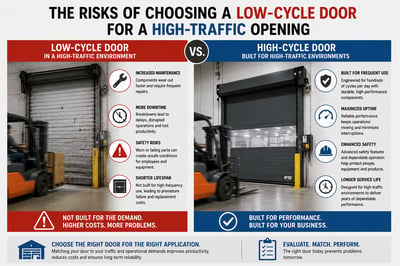
The Risks of Choosing a Low-Cycle Door for a High-Traffic Opening
Many businesses focus primarily on upfront costs when purchasing overhead doors.
While a conventional door may initially cost less, using it in the wrong application often leads to greater expenses over time.
• Increased Maintenance. Components not designed for frequent operation wear out more quickly. As usage increases, repair costs often rise as well.
• More Downtime. Door failures can disrupt workflow, delay shipments, and create bottlenecks throughout a facility. In distribution centers and warehouses, even short periods of downtime can affect productivity.
• Reduced Safety. A door that is operating beyond its intended capacity may develop worn components that compromise safe operation. Unexpected failures can create hazards for employees, equipment, and inventory.
• Shorter Equipment Life. Low-cycle doors simply are not built for high-frequency use. Repeated operation accelerates wear and shortens the lifespan of critical components.
The Risks of Choosing a High-Cycle Door for a Low-Traffic Opening
While less common, selecting a high-cycle door where one isn't necessary can also present challenges.
• Higher Initial Cost. High-speed overhead doors typically involve greater upfront investment due to advanced technology and specialized components.
• Underutilized Features. If an opening only experiences a few cycles per day, many of the benefits of a high-performance door may never be fully realized.
• Maintenance Considerations. Although modern high-speed coiling doors are extremely reliable, any door system benefits from regular operation. When doors remain closed for extended periods, seals, sensors, and moving components may require periodic inspection to maintain optimal performance.
• Energy Efficiency Considerations. One area where high-speed roll-up doors often provide substantial value is energy efficiency. Traditional commercial doors generally remain open longer during each cycle. This allows conditioned air to escape while outdoor air enters the building. Fast-opening doors minimize this problem by opening and closing rapidly.
Benefits include:
✓ Reduced energy loss
✓ Improved climate control
✓ Better temperature management
✓ Lower heating costs
✓ Lower cooling costs
✓ Enhanced environmental separation
These advantages become particularly important in climate-controlled facilities and refrigerated environments.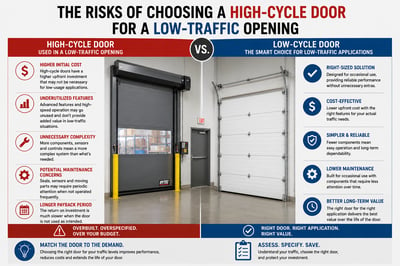
Productivity Benefits of High-Speed Doors
The impact of door speed is often underestimated.
When forklifts, employees, and vehicles repeatedly wait for a conventional door to open and close, those delays accumulate throughout the day.
Fast-acting doors help eliminate bottlenecks by:
✓ Improving traffic flow
✓ Reducing wait times
✓ Increasing operational efficiency
✓ Supporting automation systems
✓ Enhancing logistics performance
In large facilities, the productivity gains can be significant. Before selecting a door system, it is important to assess how each opening is used.
Questions to consider include:
1. How Many Cycles Occur Daily?
An opening used ten times per day has very different requirements than one used 300 times per day.
2. What Type of Traffic Uses the Opening?
Forklifts, employees, trucks, and automated equipment all create unique demands.
3. Is Climate Control Important?
Facilities requiring temperature control often benefit from high-speed door solutions.
4. How Critical Is Uptime?
In some operations, a door outage is merely an inconvenience. In others, it can halt production or shipping activities entirely.
5. What Are Your Long-Term Goals?
The lowest upfront cost is not always the most economical solution over the life of the door. Evaluating total ownership costs often leads to better long-term decisions.

Cost Versus Return on Investment
When comparing door options, many facility managers focus on purchase price.
However, the true cost of ownership includes:
✓ Installation costs
✓ Maintenance expenses
✓ Repair frequency
✓ Energy consumption
✓ Downtime costs
✓ Productivity impacts
✓ Equipment lifespan
A high-performance overhead door may require a larger initial investment, but its durability, reliability, and operational benefits often deliver substantial long-term savings. For high-traffic applications, the return on investment can be significant.
The Best Solution Is Often a Combination
Many facilities benefit from using both low-cycle and high-cycle doors strategically.
For example:
✧ A distribution center may use rolling high-speed doors at loading docks and warehouse passageways.
✧ Storage areas may utilize conventional rolling steel doors.
✧ Employee entrances may use sectional overhead doors.
✧ High-traffic production zones may rely on rapid-opening roll-up doors.
This approach allows businesses to maximize performance while controlling costs.
Selecting between low-cycle and high-cycle overhead doors is about much more than purchasing equipment. It is about matching the right solution to the demands of each opening.
Facilities that accurately evaluate traffic patterns, operational requirements, energy efficiency goals, and long-term costs are more likely to achieve reliable performance and maximize their investment.
Whether your facility requires a traditional rolling steel door, a commercial sectional door, or a high-speed rolling door engineered for constant operation, choosing the proper system can improve productivity, reduce maintenance expenses, and support years of dependable service.
The key is understanding how your facility operates today, and how it may evolve tomorrow.

For over 40 years, we have helped businesses throughout New Jersey and the New York City metro area find the right commercial overhead doors for every application. Whether you need a high-speed rolling door for a busy warehouse or a durable rolling steel door for a low-traffic opening, our experts can help.
Contact Us
Phone: 973-471-3358
Email: info@rollupdoorsnjny.com