
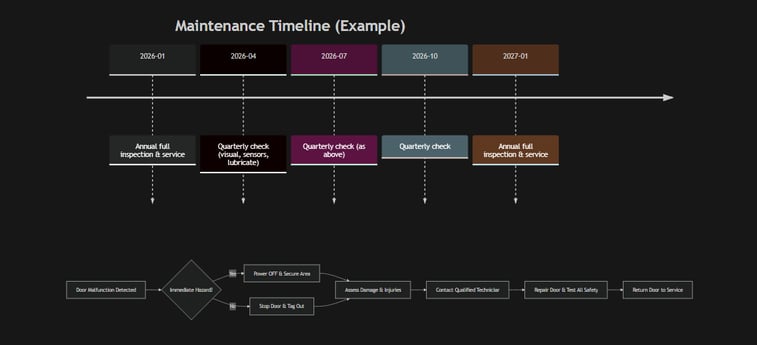
Proactive maintenance is critical for reliable operation of parking commercial garage doors. Their manuals specify daily, monthly and annual checks. For high-performance roll-up doors, quarterly inspections at minimum are recommended.
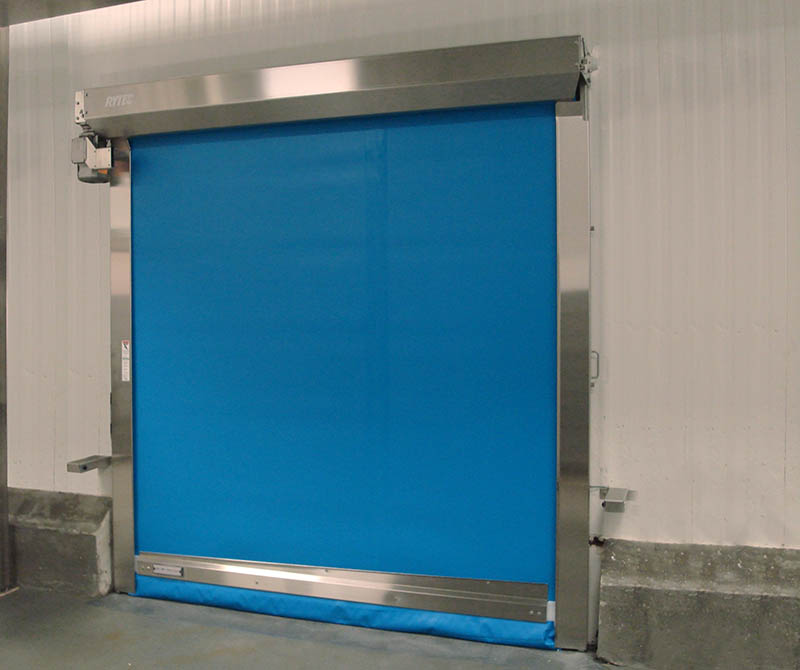

Key tasks include visual inspections (panels, tracks, hardware), testing safety sensors and reversers, tightening fasteners, checking belt/chain tension, and lubricating moving parts (springs, rollers, bearings) as needed. Environmental factors (salt, extreme temperature, dust, wind) increase wear and call for more frequent checks.
This guide summarizes Rytec model types, recommended maintenance intervals and tasks, compliance standards, cost ranges, and emergency procedures, with example schedules and checklists for low/medium/high usage scenarios.
Door Types & Usage Scenarios
Rytec makes several door families; if your model is unspecified, assume a Spiral high-speed roll-up door, common in parking structures. Other types include sectional overhead doors, rigid steel roll-ups, sliding doors (Turbo-Slide®), and fabric/rubber doors (Fast-Seal®, FlexTec®). Each has similar inspection needs, though some (like Spiral doors) are designed for minimal lubrication of the panel and track. All share a need to inspect seals, hardware, and safety devices. High-usage doors (e.g. 50+ cycles/day) wear faster; low-use doors (<10 cycles/day) require less frequent service.
✔ Low-use (<10 cycles/day): Annual professional service; monthly basic checks.
✔ Moderate-use (10–25 cycles/day): Semiannual service (twice/year) plus monthly in-house inspections.
✔ High-use (25–50 cycles/day): Quarterly professional service; daily/weekly visual checks.
✔ Extreme (>50 cycles/day): Every 2–3 months or continuous maintenance contract
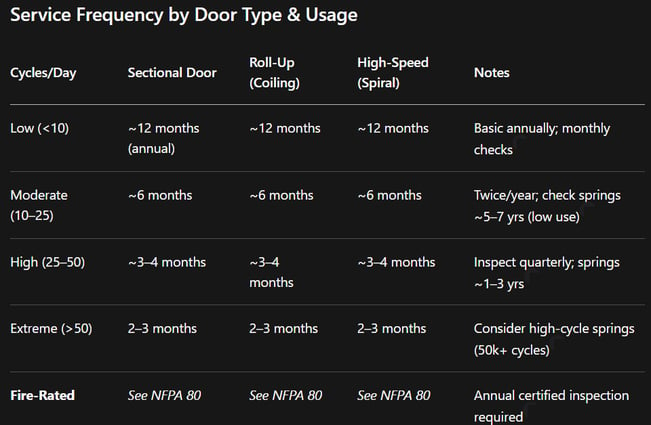
Table: Rough maintenance interval by door type and daily cycle count (adapted from industry guidelines). “High-speed” refers to fabric/steel spiral doors.
Inspection & Maintenance Tasks
Follow Rytec’s owner manual for your model. Typical tasks by interval include:
• Daily/Weekly: Walk the door’s path; ensure no obstructions. Do a quick visual scan of the door, panels, side frames, bottom bar and seals for damage or wear. Run the door through a few open/close cycles; listen for unusual noises. Verify the door opens and closes fully without binding. Check warning lights and ensure photo-eyes are clean and aligned. At the end of day, many operators log any issues to address.
• Monthly: Inspect and clean photo-eye sensors (test reversal with an object). Lubricate rollers, hinges, spring coils, drive chains/gears and locks per the manual. Tighten any loose fasteners or anchors around the motor, track brackets and safety device mounts. Verify weather seals and gaskets are intact (replace torn edge seals). Check the control panel for error lights and that all limit switches are set.
• Quarterly: In addition to monthly tasks, perform a full inspection: check door balance (with opener off, door should stay at mid-height). Test emergency manual release and brake. Inspect springs, cables or straps for fray, and adjust belt/chain tension to spec. Clean the tracks and lubricate as needed (some Spiral models do not require track lubrication). Inspect drive motor and gearbox mount (tighten set screws on driveshaft). If the door has a reversing edge, tap it during descent to ensure immediate reverse function. Document cycle count and component wear in a report.
• Semi-Annual: Repeat quarterly checks plus any mid-term adjustments. Many operators replace parts on a schedule (e.g. torsion springs every ~5–7 years if cycles are moderate) rather than waiting for failure. Verify safety labels are legible and emergency signage is in place.
• Annual: Comprehensive service by qualified technicians. Replace wear-items as needed (springs, cables, bottom seals). Perform all electrical inspections (motor wiring, encoders, control boards). For fire-rated doors, conduct the required drop test and relatch procedures. Provide a detailed maintenance report.
Note: Some Rytec high-speed rolling doors use sealed gearboxes and are pre-lubricated, so do not grease them (manuals warn against excess lubricant attracting dirt). Only lubricate the points specified.

Environmental and Usage Factors
Harsh environments demand tighter schedules. For example:
• Salt/Coastal Exposure: Corrodes springs and hardware. Plan extra visits (add ~1–2 per year) and use corrosion-resistant greases. Lubricate more frequently (every 2 months).
• Chemical or Humid Environments: Accelerates rust; keep parts well-lubricated and clean. Inspect quarterly at minimum.
• Extreme Temperatures/UV: Check seals and hydraulic fluids in winter/summer extremes. Freeze-proof or heat-stable lubricants may be needed. Inspect seals at each visit (sun-bleaching and cracking).
• Wind-Loading: After storms or high winds, immediately inspect door anchoring and tracks for skewing or loose panels.
• Dust/Debris: Construction or agricultural dust can clog tracks and sensors. Clean and lubricate as often as monthly in these cases.
Any increase in traffic (loading schedule changes, seasonal peaks) should similarly raise inspection frequency.
Compliance & Safety Standards
⁃ Rytec Manuals: Always follow the model’s manual checklist. Rytec notes that following the recommended schedule is essential to avoid downtime. Manuals list daily/monthly/annual items.
⁃ UL 325 / UL 603: Although these cover residential, the safety principle applies: test the auto-reverse and photo-eyes monthly as a minimum (place a 1½″ object under the closing door). Log compliance.
⁃ OSHA: No specific OSHA code for overhead doors, but OSHA enforces general machinery maintenance. Failure to maintain safe equipment can incur serious violation fines. Keep maintenance records.
⁃ NFPA 80: If any door is fire-rated, it must be inspected and tested annually by code. The drop test and reset must be documented.
⁃ Local Codes: Check local building/fire codes for frequency requirements or documentation mandates. Maintaining doors can lower insurance risk.
Warning Signs: When to Call for Help
Make safety your top priority. Stop using your high-speed coiling door and call service immediately if you notice:
✓ Sudden loud bangs or popping sounds (likely a broken spring or cable).
✓ Door drifting or hanging to one side (cable/spring failure imminent).
✓ Wire or cable fraying, loose spring ends, cracked drums or broken rollers.
✓ Inoperative safety devices (door fails to reverse on test).
✓ Excessive slamming or slowing, which can indicate motor/brake fatigue.
✓ Any visible crack in structural components or collision damage.
Document these observations in daily logs. Quick response prevents injuries and saves on larger repairs.
Annual Plan & Emergency Response
Implement an annual service contract with a qualified Rytec dealer like us. This ensures scheduled visits, priority support, and trained technicians familiar with Rytec System 4 controls. Your plan should include: two or more inspection visits per year (as needed by usage), lubrication, and tuning.
Emergency Response Steps: In case of a door failure or emergency:
1. Shut off power at the disconnect immediately.
2. Secure the area: Block access under a stuck door.
3. Inspect visually: Note any obvious breakage or hazards (springs, cables).
4. Contact Rytec support or your service contractor (most offer 24/7 emergency service).
5. Follow up: After repair, verify all safety functions before returning to normal operation.
Staying proactive with maintenance ensures safety, compliance, and longevity of your Rytec garage doors. Regular inspections and servicing (guided by Rytec’s manuals and industry best practices) prevent costly downtime and accidents. Prioritize scheduled upkeep and your doors will reliably serve for many years.
Contact Us
Phone: 973-471-3358
Email: info@rollupdoorsnjny.com

%20NYC%20NJ.png)